Showing posts with label Barry Sears. Show all posts

3/08/2010

Review of Omega Rx Zone: The Miracle of the New High-Dose Fish Oil (Mass Market Paperback)

This book gives a complete and easy to understand of the complex way in which the EPA&DHA long-chain fatty acids influence the hormonal system, and how their lack in the diet affects the body. The author explains why eating fish is not the best way to get omega-3's, mainly because of the heavy chemicals that fish accumulate in their tissues. He describes the differences between different types of fish oil and why (in his opinion) pharmaceutical-grade fish oil is the best way to supplement omega-3. He explains which blood test will tell you how healthy you are.

There is also a very interesting hypothesis on how a diet rich in omega-3 helped the development of the human brain in its early stages of evolution.

There are detalied explanations of how diseases such as cancer and auto-immune illnesses are related to long-chain omega-3's. The author explains how "silent" (cell) inflammation is the cause of many (if not most) major diseases today, especially chronic conditions.

There are explanations of the relationship between omega-3's and emotional well-being, as well as how they improve mental abilities.

As a sidenote, apparently there is currently only one brand on the market that satisfies the author's standards. They have a comparison table on their website showing how their brand offers the most omega-3 per dollar (to convince that it is worth the high price)--but they only compare with certain brands--and I know of at least another highly respected fish oil brand that offers even more omega-3's for half the price. So the only argument left is that pharmaceutical-grade fish oil is completely free of contaminants, whereas other types of oil are not. This argument is in my opinion not very strong, because there are enough brands (such as the one I was talking about before) that have levels of contaminants so small that they are not detectable in a lab--therefore which are really of negligible risk (compared for instance with the toxic substances found in our tap water).

Nevertheless, the in-depth analysis on the remarkably positive effects of EPA&DHA's on health is excellent, and I highly recommend this book.

Product Description

The Next Generation of the Zone!


Dr. Barry Sears is one of the world's most trusted voices on health, diet, and nutrition. Over the past decade, millions of people worldwide have followed his prescriptions for healthy living through his bestselling books. He introduced the world to the Zone, a state of improved hormonal control that has helped a generation of people lose excess body fat, reverse the aging process, and fight heart disease and diabetes.


In The Omega Rx Zone, Dr. Sears reveals a revolutionary new technological advance that helps treat chronic disease, improves athletic performance, and more. Never before available to the public, pharmaceutical-grade fish oil has the potential to make you a more emotionally stable, healthier person by allowing your brain to work at peak efficiency and controlling the hormonal responses that ultimately govern your body and mind. Drawing upon his own research as well as recently published studies, Dr. Sears shares new understanding of heart disease, cancer, depression, Alzheimer's, attention deficit disorder, chronic pain, Type 2 diabetes, infertility, and multiple sclerosis. Used in conjunction with the Zone program, these findings can help you to:

  • Increase brain vitality and longevity
  • Maximize physical performance
  • Lose weight-and keep it off
  • Reverse chronic disease


Click Here to see more reviews about: Omega Rx Zone: The Miracle of the New High-Dose Fish Oil (Mass Market Paperback)

2/27/2010

Review of The Fat Flush Plan (Hardcover)

I bought this book, along with the cookbook, on Amazon a month ago and followed the diet plan closely for the first two weeks (I lost 13lbs.) and loosely for another 7-10 days for a total weight loss of 27lbs.It is not the easiest diet to follow, as the flax oil tastes really icky and the flaxseed fiber supplement drink is equally hard to swallow, but if you actually do what the author suggests, you Will lose weight.What I found the most difficult was eating eggs without salt and topping my protein portions with the flax oil as suggested.I think (I cannot prove it with personal research), that flax oil is much the same as linseed oil.It's not the initial taste, but the lingering aftertaste that put me off.I did learn how to cut back on carbs, fats and sodium (it's amazing what you can do with mustard and hot sauce) and did manage to modify my long term dietary intake, but after a month, I wanted to taste a grilled steak with garlic salt and maybe even a touch of butter, not to mention a crusty bit of bread!If you are more committed and have more willpower than I do, you can really lose a significant amount of weight on this plan and alter your palate.I have maintianed my weight loss (except for 4 lbs.), which is probably water weight due to increased sodium intake) and am very happy with the plan.I did lose a good amount of weight and learned alot on how to control portions and refined carbs without any real discomfort.The cookbook has lots of really good recipes, most of which could be elevated to stardom with some off-limits additions of butter!The mock mashed potatoes, using cauliflower was a real hit in my household and is still something I will fix regularly.This is an effective but not entirely painless diet plan suited for someone with real dedication.I thank the author sincerely for the many pounds I lost initially and for the good advice that I continue to follow.It's worth trying, especially if you have 20+ lbs. to lose!


Click Here to see more reviews about: The Fat Flush Plan (Hardcover)

2/19/2010

Review of The Anti-Inflammation Zone: Reversing the Silent Epidemic That's Destroying Our Health (Hardcover)

Few books prompt me to want to TELL THE WORLD because it may make a big difference in the quality of life of anyone who reads it.This is the first book I've read about the Zone diet, inflammation and fish oil supplements so it was all news to me and makes sense.An excellent companion book is Zone Meals in Seconds which enabled me to apply the theory using recipes, canned/frozen food, and even restaurant visits.

A high cholesterol report and watching Morgan Spurlock's movie, Super Size Me, prompted me to pursue some changes in my diet.in the month since entering the Zone I have discontinued Sudafed use (after years on it) and my husband is off of glucosamine and pain free.Plus, we are not hungry, have energy, and sleep better than before.Don't underestimate the health effects of the right food if you are currently in pain or taking any medications this book "might help, won't hurt".

Product Description

Combat silent inflammation --
the most serious health
threat you never heard of


Heart disease is the #1 killer of Americans.
Cancer is the #1 fear of Americans.
Dementia is the #1 concern of Americans.


What do these devastating illnesses have in common? All three have been linked to silent inflammation, a condition that occurs when the body's natural immune response goes awry. Silent inflammation can continue undetected for years, continually assaulting the heart, arteries, and even the brain -- and you will not even know it.


New research confirms that obesity is a primary cause of silent inflammation. And inflammation is the smoking gun that links excess body fat to today's epidemic rise in heart disease, cancer, dementia, and countless other health threats. Although the science of this relationship is complex, the bottom line is simple: If not detected and reversed, silent inflammation will devastate generations of Americans and bankrupt an increasingly stressed health care system. The medical establishment appears to be ignorant about this problem, politicians don't talk about it -- and yet virtually everyone in the country is affected by it.


In his number one New York Times bestseller The Zone, Dr. Barry Sears revolutionized the way we think about nutrition when he showed that a high-carbohydrate diet is a real risk to our health. Now, with eye-opening new research in the field of hormonal control and nutrition, Dr. Sears offers the first comprehensive plan to combat silent inflammation. This important book gives us the tools and tests we need to assess the current level of silent inflammation in our bodies -- and determine our future health.


As you'll discover, the Zone dietary plan -- including supplements of high-dose, ultra-refined fish oil -- is the best way to get the hormonal control you need to reduce inflammation. In The Anti-Inflammation Zone, Dr. Sears shows exactly what steps to follow to reduce your risk of each disease and condition, or to reverse it if you have it already -- in only thirty days. And the Zone Lifestyle Program includes a week of delicious Zone-friendly meals, easy home exercises, and important stress-reducing methods -- all of which work together to put you on a path toward wellness that will improve the rest of your life.


The day you start fighting silent inflammation is the day that you start to slow down the aging process -- and all the chronic diseases that come with it. Welcome to the Anti-Inflammation Zone -- and the return to wellness.


Click Here to see more reviews about: The Anti-Inflammation Zone: Reversing the Silent Epidemic That's Destroying Our Health (Hardcover)

1/13/2010

Review of A Week in the Zone: A Quick Course in the Healthiest Diet for You (Paperback)

Finally, Barry Sears has gotten around to writing a "how-to" book on the Zone Diet.All of the previous books were somewhat technical, and aimed at medical professionals or personal trainers.
This book, hisfirst paperback, is written in a clear, concise and easy to understandstyle.By the end of the first 20 pages, you will have a good idea of whatthe Zone Diet is about, its benefits and how it works.
Then, the rest ofthe book gives Sears' simplest yet version of the diet (for example,instead of "40-30-30" the new restatement uses"1-2-3").
The Zone Diet, by the way, is primarily a healthdiet, although it is also effective for weight loss. The idea is to keepyour blood sugar and hormone levels as even as possible, by balancing whatyou eat in each meal. The result is a number of health benefits,especially in the areas of diabetes (demonstrated by a clinical study) andheart disease (Sears started the research due to the high mortality in hisown family tree), but also in other areas like allergies, joint pain,headaches, stomach acid, and many others, all of which are aggravated byour modern unnatural eating habits.
Unlike almost all other eating plans,this diet is based on an investigation of how food affects our bodies'mechanisms, and the result is simply better functioning.

Product Description

A national bestseller for more than three years in hardcover, The Zone has introduced millions of people worldwide to a breakthrough approach to dieting based on Novel Prize–winning scientific research. Treating food as the most powerful drug available, The Zone plan shows how food, when used unwisely, can be toxic. Used wisely however, it will take anyone into the Zone, a state of exceptional health familiar to champion athletes.


Now the benefits of Barry Sears߲evolutionary program can be experienced in just one week! With A Week in the Zone, everyone can start on the path to permanent weight loss and learn how to burn body fat, and keep it off – without deprivation or hunger.


They'llalso discover how the Zone helps to both increase energy and fight heart disease, diabetes, PMS, chronic fatigue, depression, and cancer.


Click Here to see more reviews about: A Week in the Zone: A Quick Course in the Healthiest Diet for You (Paperback)

12/24/2009

Review of Mastering the Zone: The Next Step in Achieving SuperHealth and Permanent Fat Loss (Hardcover)

It isn't always easy to prepare menus and cook food ahead of time, but if you can do it, then you're on your way to healthier eating.Dr. Sears explains his "diet" better to non-medical people in this book. This isn't a high-protein diet or a no-carbs diet as some of the othercontroversial diets are and some critics claim this to be.It really is ahealthy way to eat.I work for a doctor whose specialty is type 2 diabetesmellitus, and limiting those refined carbohydrates is proven to help thosewith all forms of insulin sensitivity.Limiting refined sugars andincreasing intake of fruits and vegetables, adding the heart-healthy HDLcholesterol via monounsaturated fat, and eating sensible amounts of low-fatprotein will help anyone maintain or lose weight, control blood sugar, andstay healthy with more energy.I lost 20 lbs., with 4 inches reduced frommy stomach, and I didn't even have to exercise.Imagine if I had addedsome walking or other activities!Dr. Sears's suggestions I try toincorporate into my daily life, even those times when I am not as strict asI should be.I would highly recommend this book for anyone struggling witha weight problem or just anyone wanting to be healthier.


Click Here to see more reviews about: Mastering the Zone: The Next Step in Achieving SuperHealth and Permanent Fat Loss (Hardcover)

12/15/2009

Review of Good Fat: Low-Carb: With 100 Recipes (Paperback)

This book made a great deal of sense. We have been on the low fat kick for years and obesity has kept increasing. We eat more of less satisfying foods. I switched and find that I am far more satisfied and eat less of really good things,because they are truly more satisfying.It's a good investment in your health.


Click Here to see more reviews about: Good Fat: Low-Carb: With 100 Recipes (Paperback)

12/12/2009

Review of The Zone: A Dietary Road Map to Lose Weight Permanently : Reset Your Genetic Code : Prevent Disease : Achieve Maximum Physical Performance (Hardcover)

After a lot of encouragement from my mother, who has been following the Zone for two years, I decided to try this diet.I've been on it for 3 months and I've lost 28 pounds and 2 clothing sizes without really changing my modest exercise habits.I eat half as many calories as I used to, but I'm not hungry.I used to have terrible insomnia, often getting no more than 4 hours of sleep a night - that has vanished along with my nearly-constant heartburn.After two months, my blood cholesterol dropped from 200 to 180.I have energy to burn.I take a Cheat Day on Sundays when I eat all the evil things I've been craving that week - croissants, Nutella, McD's sausage biscuits, creamy desserts - and by the end of the day I feel so draggy, dehydrated, sinus-y, that it's a relief to wake up Monday morning and go back onto the plan.
So, why don't I recommend this book?It was the first book Barry Sears (co-)wrote about the Zone, and it reads like an infomercial.The writing style is... loud.It is also poorly organized, jumping around from biochemical jargon to little tidbits of practical advice to anecdotal evidence to health claims for different conditions.And finally, this book doesn't provide any information beyond the very basics about how to actually follow the plan.If you are already convinced (perhaps by all these glowing reviews) of the benefits of the Zone and want to jump right in, the more comprehensive Mastering the Zone with its tons of practical tips is a much better place to start.If after beginning the diet you want more background information about how it works, then pick up this book.The one good thing about the early book is the more gourmet recipes (like the lamb with herbed cheese on zucchini-and-squash "pasta" - mmmm!).There are more recipes in Mastering the Zone, but for my taste they stick too strictly to the glycemic-index guide and also try too hard for one-pot meals; I've never used them.
An issue to look out for: I found that the body fat tables in the back way overestimated my fat weight, which meant an artificially low food intake level.After a couple of weeks hovering on the edge of hunger, I got my body fat percentage measured on a machine at the employee wellness office at work and got a result of ten percentage points less!I raised my food intake and continued losing weight at a healthy clip, with no more hunger pangs.I suspect that the bodyfat-table problem may be why a few reviewers here felt hungry on the Zone.The tables probably underestimated their lean weight, resulting in recommended food intakes that were too low.
The bottom line: even if all the health claims aren't sound, this is a balanced low-calorie diet that's easy to follow indefinitely without hunger, and what can be wrong with that - unless you are Nabisco Foods or something?Just try to start with Mastering the Zone instead.


Click Here to see more reviews about: The Zone: A Dietary Road Map to Lose Weight Permanently : Reset Your Genetic Code : Prevent Disease : Achieve Maximum Physical Performance (Hardcover)

11/15/2009

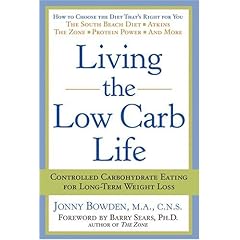
Review of Living the Low Carb Life: Controlled Carbohydrate Eating for Long-Term Weight Loss (Paperback)

Here's my chapter-by-chapter review of this book.A little long, but should give you a good idea of what the book contains.

---

Chapter 1: The History and Origins of Low-Carb Diets

This was a fun chapter. Jonny Bowden talks about the history of low-carbohydrate diets, from William Banting and Dr. William Harvey all the way to Dr. Barry Sears (The Zone). We find low-carb diets did not start with Dr. Robert Atkins in 1972, but actually with Mr. Banting's publication of Letter on Corpulence in 1864. So low-carb has been around much longer than the low fat dogma that has only been popular the last 30 years. The concept of the calorie wasn't even discovered until between 1890 and 1900 by a man with the name of Wilbur Atwater.

Mr. Bowden goes through all this and more, touching on each of the major players in diet from 1864 onward. Many of the people named I had never heard of before. There's so much more to this low-carb lifestyle than one man in New York in the 70s!

Very good chapter and I highly recommend it.

Chapter 2: Why Low-Carb Diets Work

Jonny Bowden gets somewhat technical in this chapter, and I admit parts were over my head. It talks about how our bodily system work, with a focus on insulin since it is a key reason low fat/high carb diets don't work. It talks about blood sugar, cholesterol (both HDL and LDL), and triglycerides. It explains why a diet high in carbohydrates has an adverse impact on all of these.

He spends extra time on insulin, insulin resistance, and diabetes. He talks about insulin as the "fat-storage hormone" and most importantly, what goes on in the body to cause this. The chapter can be summed up best in one sentence: "Controlling insulin is the number one priority of all low-carb diets" (page 64).

As I said, parts are quite technical, but most of the chapter was understandable. It left me thinking, "Why would I ever want to put so many carbs in my body when they do such horrible things?

This is the chapter to read if you want to know the scientific reasons a low carb diet works and what goes on in your body when you are on a traditional low fat diet.

Chapter 3: The Diets

In chapter 3, Jonny Bowden takes pains to list the positives and negatives of all the diet plans he profiles. With those that get a low rating, such as Lindora, he mentions what is good about the program. And with the highest rated, such as Atkins, he mentions the faults he sees. So far from being overly biased, he does his best to highlight the whole story behind all the diets - good and bad.

Here's all the diets and how they rated, from top rated down to lowest rated. When more than one program has the same rating they are in alphabetical order. If you want to know Mr. Bowden's reasoning behind these ratings, you'll have to get the book! :) Below each diet I will put my comments.

The Atkins Diet - 5 stars

I am, of course, biased toward this program because it is my plan. :) Atkins is high-fat, low-carb, consisting of four phases, each one less restrictive than the last.

Favorite quotes:
"But you have to realize that in 1972, banning these foods [high carbohydrate foods] for even two weeks was the nutrition equivalent of suggesting that every school and office in the country burn the American flag. These foods were the holy grail of low-fat religion" (pg. 68).

"Atkins has been one of the most misunderstood diet authors and has been the target of more attacks than any other low-carb proponent, probably because his was the first and the most commercially successful of the plans and also, to the constant chagrin of the establishment, because he simply wouldn't go away" (pg. 72).

The Fat Flush Plan - 5 stars

A good basic plan. There really isn't anything bad to say about it. It restricts wheat, dairy, and sugar, which some people are sensitive to in which case these foods would cause bloating.

The Hamptons Diet - 5 stars

Favorite quote:
"Dr. Pescatore points to the fact that the American Heart Association diet - which recommends limiting total dietary fat to less than 30 percent of the diet and saturated fat to less than 10 percent - fails to lower triglycerides and actually lowers HDL (good cholesterol). In addition, the AHA diet has never consistently shown long-term improvement in any heart disease outcome" (pg. 107).

Protein Power - 5 stars

Not much to say. It's a very good, well-balanced low carb diet.

Interesting feature of the diet:
It has three levels, representing your level of commitment. The higher the level, the more healthy you will be. You'll have to get the book for the full explanation, but here's the name of the levels.

Purist - very restrictive
Dilettante - a little less restrictive, but still bans certain foods; the authors themselves are on this level
Hedonist - the least restrictive; anything goes as long as you stay within your allotted carbs and get the amount of required protein

If I had to go on this diet I would most certainly be a hedonist!

Interestingly enough, I recently stumbled upon Dr. Michael Eades' blog and have been reading it.

The South Beach Diet - 5 stars

Consisting of three phases and a good carbs/good fats approach (after the initial low-carb approach of Phase 1), the diet's true genius was that Dr. Agatston managed to get accepted by the mainstream. This is probably do to his demonization of saturated fats, which Mr. Bowden feels is dead wrong. However, if it can get people eating less carbs, that's a good thing.

I can't find fault in this diet. It encourages people to eat carbs in the amount their individual bodies can handle them, and there's nothing wrong with that.

Best (if not favorite) quote:
"The genius of Agatston is that he has taken this information and make it extremely user-friendly and accessible, and has done so while making sure not to alienate his more conservative colleagues in the medical profession. This makes it much more likely that his important message will be heard" (pgs. 155-156).

The Zone - 5 stars

Consists of 40% carbs/30% protein/30% fat.

Mr. Bowden then takes time to explode some basic myths about the diet.

1) "The Zone is not a high-protein diet" (pg. 161). It includes about 112g of protein a day.
2) "The Zone is also not a low-carb diet" (pg. 162). It includes about 150g of carbohydrates. (Yikes! Way too high for me. Any more than about 90g a day and I get the most horrible cravings.)
3) "The Zone was never meant solely as a weight loss diet. It was designed to reduce heart disease through the control of inflammation" (pg. 162).

In this section Mr. Bowden touches on the topic of eicosanoids. Very interesting stuff. Don't skip it.

He says that Dr. Sears has "almost singlehandedly forced the dietary establishment to reevaluate the prohibition on fats" (pg. 165), and that 40/30/30 beats the USDA food pyramid any day of the week. He says the Zone is a good place to begin, even if you later move on the a different program.

The 7 Day Low-Carb Rescue and Recovery Plan - 4 stars

By the same authors as the The Carbohydrate Addict's Diet. This is a week-long program and not a lifestyle. It's meant to transition you slowly into the Carbohydrate Addict's Diet. (See below for more on this.)

The GO Diet - 4 stars

Favorite quote:
"Fruits today are definitely not the same fruits out ancestors ate. Our fruits have been bred and engineered for far more sweetness than the bitter little things that our Paleolithic ancestors gathered" (pg. 102).

The Schwarzbein Principle - 4 stars

Mr. Bowden says that every low-carber should have the original Schwarzbein Principle in their library. He also says that if you aren't familiar with the case against a low-fat diet that this book is a good place to start.

The Schwarzbein Principle focuses on both insulin (as all low-carb diets do), but also on having healthy adrenal glands. This is what sets it apart from all other low-carb diets.

Why does it get only 4 stars? Because it's not really a weight loss plan. "As an overall plan for health, this is five-star material. But as a weight loss diet - which it was never intended to be - it may not be the ideal entry-level plan, as it requires a good deal of patience and lots of commitment" (pg. 146).

The Carbohydrate Addict's Diet - 3 stars

Two "on plan" meals a day consisting of mostly protein and vegetables and one reward meal, but that meal must be eaten in one hour. No snacks.

I could do a LOT of damage in one hour. This program would never work for me.

Neanderthin - 3 stars

Notable quote:
"Until the advent of agriculture, grains, beans, potatoes, milk, and refined sugar were not part of the human diet" (pg. 119).

This is SO true! Agriculture has only been around for 10,000 years. Our digestive tracts don't change that quickly. Our bodies are much better suited for a hunter/gatherer diet - low carbohydrate, high protein and fat.

Interesting feature of this diet:
"You...shouldn't drink alcohol, though he [the diet's author] says that if you must, you can do damage control by drinking fruit-based alcohol such as wine or champagne" (pg. 121).

No quibble here. I'm a wine girl all the way!

Favorite quote:
"A vegetarian diet, says Audette, is about as natural to humans as a diet of Cheerios to a lion" (pg. 122).

I...Read more ›

Product Description
The first and only book that combines history, science, tips, facts and resources in a concise yet comprehensive review of all the low-carb programs, so that dieters can choose the right one.

The low-carb revolution is changing lives, and ordinary bodiesinto beauties. But the sheer volume of information on the subject can be overwhelming. This comprehensive guide cuts through the confusion, showing dieters how to choose and customize an effective low-carb plan for their own metabolisms and lifestyles. In straightforward language, weight-loss coach Jonny Bowden rates and discusses the differences between the top-selling low-carb diets-from Dr. Atkins' New Diet Revolution to The South Beach Diet to Sugarbusters and more-providing readers with the facts they need to make informed choices. There's also an explanation of the science at work behind low-carb dieting, and hundreds of practical food tips and insider secrets to make the lifestyle work.


Click Here to see more reviews about: Living the Low Carb Life: Controlled Carbohydrate Eating for Long-Term Weight Loss (Paperback)